july in the night with diamonds - newsletter #2
July started as it always does with things blowing up in the sky.
In the DC area it was an unusually mild weekend, humidity-wise, and the dry air meant fireworks weren’t obscured by a smudgy wet smokesky and we could look and drink and ooh and ah with impunity.
My adventures this month weren’t as hectic as June’s. I worked, and worked, and went to a nuclear lake; I saw a field of drunks in the exurbs of Virginia get stirred up by a group of aging punk-rockers, led by a renaissance-brained dude, who wore spiky yellow hair and flame-adorned bowling shirts before Guy Fieri ruined them.
By “worked,” I mean a few things - making art, doing my capital-J job, fumbling through domestic and parental responsibilities, and also just the constant treading of water to stay afloat in the deluge of interests and information that constantly steal my attention. This newsletter is the public processing of that water-treading.
That brainy-dude-led band I saw was The Offspring, and one of the most interesting things about them, to me, aside from a cassette of their album “Smash” being where I first heard and celebrated the phrase “Stupid dumb-shit goddamn MOTHERFUCKER” is Dr. Dexter Holland - the singer - because he’s not just the singer of this punk band that’s been around for almost four decades, but he’s also a PhD in molecular biology, and a record label owner, and a pilot who has independently circumnavigated the globe - a polymath, if you will.
And now when I think about the concept of a ‘polymath,’ it brings me around to the idea of AI - chatbots that have the entire universe of documented knowledge loaded up in their working memory. The Offspring (and Dexter) reached the audience and level of celebrity that they did in a world that was pre-AI, obviously, and even pre-internet. It was possible for people to notice and be impressed by someone like him because they didn’t always have supercomputers in their pocket - but would the same thing happen today? To the Offspring, or anyone else? And is it even possible for people to become “like that” anymore?
I don’t know. Another one of those dudes is Greg Graffin, of the band Bad Religion, who in addition to being a punk icon and elder statesman, is also a PhD in zoology and not only wrote a dissertation at Cornell titled “Evolution and Religion: Questioning the Beliefs of the World’s Eminent Evolutionists,” but also the following lyrics to the song “Against the Grain”:
Three thousand miles of wilderness overcome by the flow
A lonely restitution of pavement pomp and show
I seek a thousand answers I find but one or two
I maintain no discomfiture my path again renewed
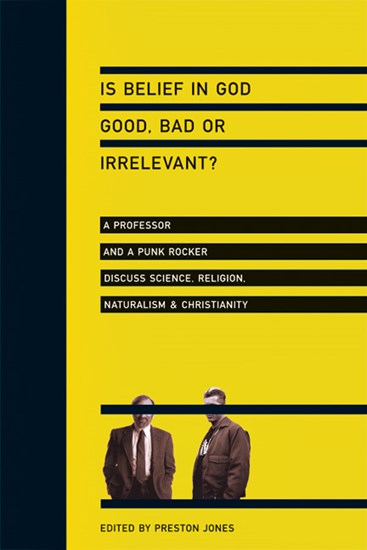
A few months ago I read a pretty interesting book that was a compilation of correspondence between Graffin and a professor of religion, debating religion. It was fascinating not just on the basis of their arguments, but in the way that they actually had an argument - courteously - in emails! - about a subject where disagreement has historically led to exile, revolution, genocide, etc. Good for them. Maybe that’s what we’ll lose when the robots take away our need for knowing stuff - the ability to have thoughtful debates with each other.
Hua Hsu just wrote in the New Yorker about AI in the context of education - what’s the point of college, now that these tools can spit out graduate-level essays in a matter of seconds? Do we still need to learn stuff the same way we used to? Well… an unexpected answer might have come from a parallel report in the Atlantic, where Lila Shroff described how she was able to prompt Google Gemini into roleplaying rape fantasies with a minor. So, maybe let’s still go to college? And not just shove all of our thinking off to these things quite yet?
In a kind of weirdly abrupt transition, the rest of the Atlantic this month was dedicated to commemorating the 80 year anniversary of the atomic bomb being dropped. (is commemorating the right word here? Or do we only commemorate things we are proud of? Cambridge Dictionary has 'commemorate war dead' as a usage example, and those people of Hiroshima are war dead, but still...)
One of the most jarring anecdotes from the Atlantic's reflection was about the film ‘The Day After’ and how after 100 million people watched its premier in 1983, the broadcaster (ABC) immediately followed it with a live 80 minute roundtable discussion between Carl Sagan, Elie Wiesel, Henry Kissinger and others, all respectfully, politely, and generally just in an adult-like way - discussing the film, and disagreeing with each other about the whole idea of nuclear armament. Can you imagine something like that happening today? What would the modern equivalent even be? Pete Hegseth and Alma Clooney and Dr. Phil or whoever the fuck sitting together for over an hour, and thoughtfully dissecting a socially-conscious film about climate change or gun violence on live TV for 100 million people?! But wait, “Ow my Balls” is on, gimmie the remote…
My family took a long weekend trip to Lake Anna, VA this month, where I’d always heard there was a ‘hot’ side and a ‘cold’ side to the water - because of the nuclear power plant - but until experiencing the ‘hot’ side, it’s pretty hard to imagine just how hot it is. I realized as I soaked in the steamy, possibly radioactive wake of a pontoon boat, that I don’t really know anything about nuclear energy, or the atomic bomb; I never had to live with the physical fear of hiding under my desk during bomb drills, and my main cultural touchstone when I think about ‘nuclear’ is Homer Simpson causing a meltdown during an inspection by Nuclear Regulatory Commission inspectors, then being forced to go to college - where he drinks beer, kidnaps a pig, and runs over the Dean with his car.
How did we go, as a country, from roundtable discussions between astronomers, Holocaust survivors and the Secretary of Defense, to 24 minute cartoons about the dumbest man in America employed to monitor a nuclear power plant? Where do we go next? The Atlantic went to great lengths in this month’s magazine to remind readers that nuclear threats are still something to worry about - plenty of warheads out there to extinct us, people! - but also we have a shiny new new existential threat (AI) to worry about while boiling lakes and three eyed fish just become recreational curiosities and iconic pop culture references.
I can’t answer that specific question - how we went from one thing to another, from a collective intelligence to a collective throwing our hands up in the air and going “whatever!”
But I CAN answer how I personally try to face down impossible questions like that, decide to ignore them, and get on with my life - by paying attention to beautiful little moments like my kid wading into a hot lake, having her picture snapped by our talented friend - and then trying to paint that image in the most carefree way I can come up with. This is one of my latest art course assignments - a daily exercise in just fucking around with different media and approaches than what I typically do. I showed it to my Dad, and he thought it had been done by my 5 year old - a success! - when I said it was mine, he responded “it’s more free-balling than your usual stuff.” I can always count on my Dad for the best critiques.
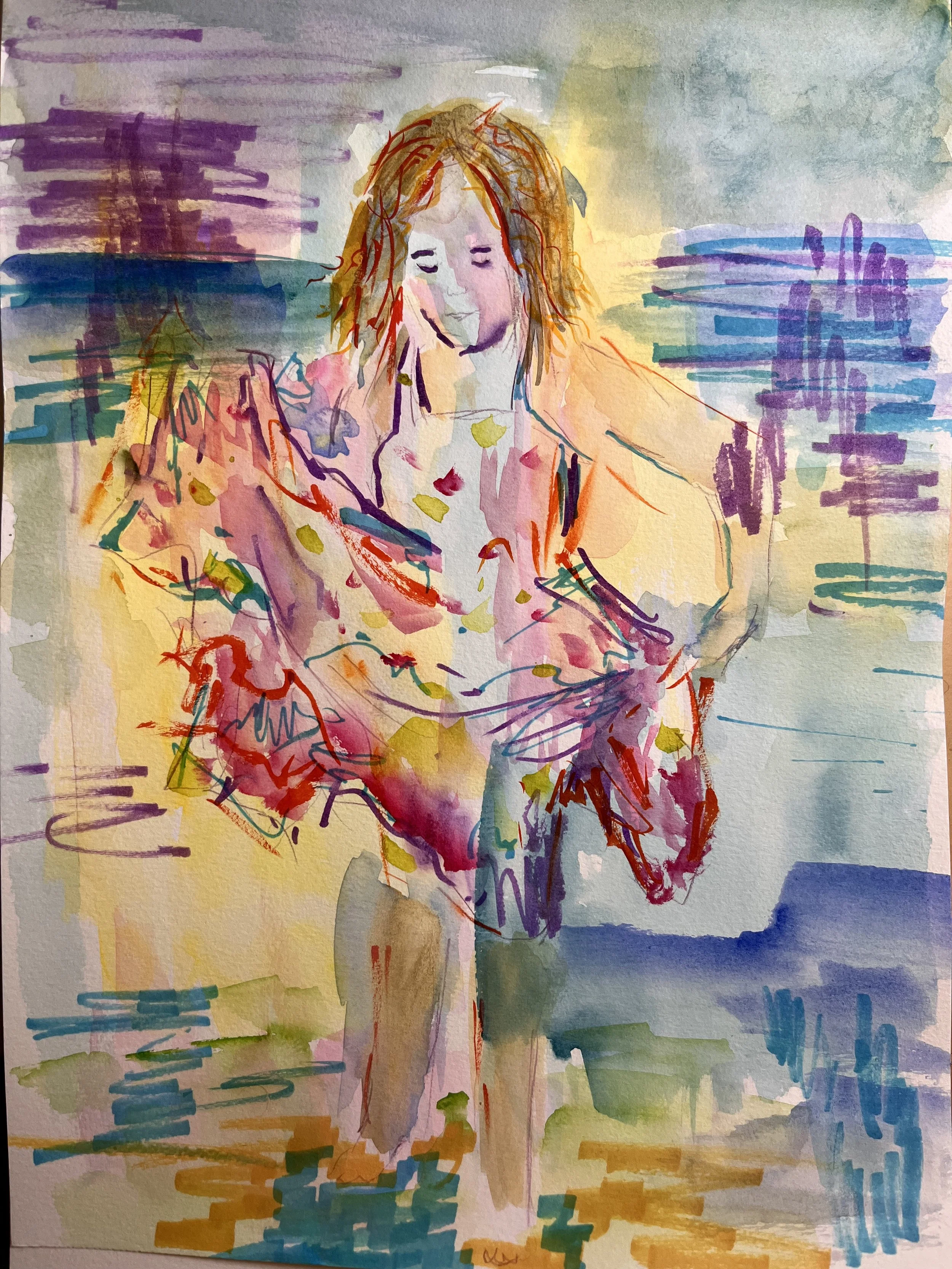
chloe in a hot lake
So, because I know what making art gives me - the freedom to ignore the possibility of nuclear holocaust - I can’t knock anybody else for doing it either. We do what we gotta to get by, whether we’re Homer Simpson or Carl Sagan or Me or Adrien Brody. Yes, even Adrien Brody - who ARTnews just burned with a report titled “Adrien Brody’s Art is Horrendous. Why are Some People Pretending It Isn’t?”
I think this comes up pretty often - when actors or other public people get attention for selling paintings. Lately this has been Ed Sheeran, and Brody - but in the past, Jim Carrey, Lucy Liu, and, I recently learned - Terry Crews!
Like I said, let the people paint. Doesn’t matter how rich or famous they already are. Even Winston Churchill needed to do it when he was taking a break from trying to kill Hitler. The ‘quality’ of their art seems to have a target on it for some people - but what is quality, anyway? (The eternal question of art criticism) I say, If you like it - good for you! But I also think it’s a bit rude to just write someone’s art off entirely because of who they are.
Sure, it’s fair to say that they wouldn’t be getting the attention and sales that they do if they weren’t who they are. And yes, I absolutely have seen work that looks A LOT like Brody’s getting sold for a hundred bucks, not the $425,000 he pocketed in Cannes earlier this year at an auction. But the same takedown logic that says Brody shouldn’t get attention just because of who he is can be applied to somebody whose parents paid for their Yale MFA before they started showing at Saatchi, too. Scoffing at nepotism or any other form of “they didn’t earn it” in the big-money art world is about as pot-kettle-black as it gets.
And as far as Terry Crews goes - his story is incredible, being a guy who was a professional football player, got cut from the team, and had to start making his living some other way. Until he found acting (and thank god he did, because he gave us President Camacho) he made ends meet by painting portraits of other football players. That’s pretty fucking cool, and I can’t think of a painting I’d love to have in my home more than one by Terry Crews of Brian Mitchell, DC sports legend (and 22 years after retirement, still the NFL record holder for all-time kick return yards!)
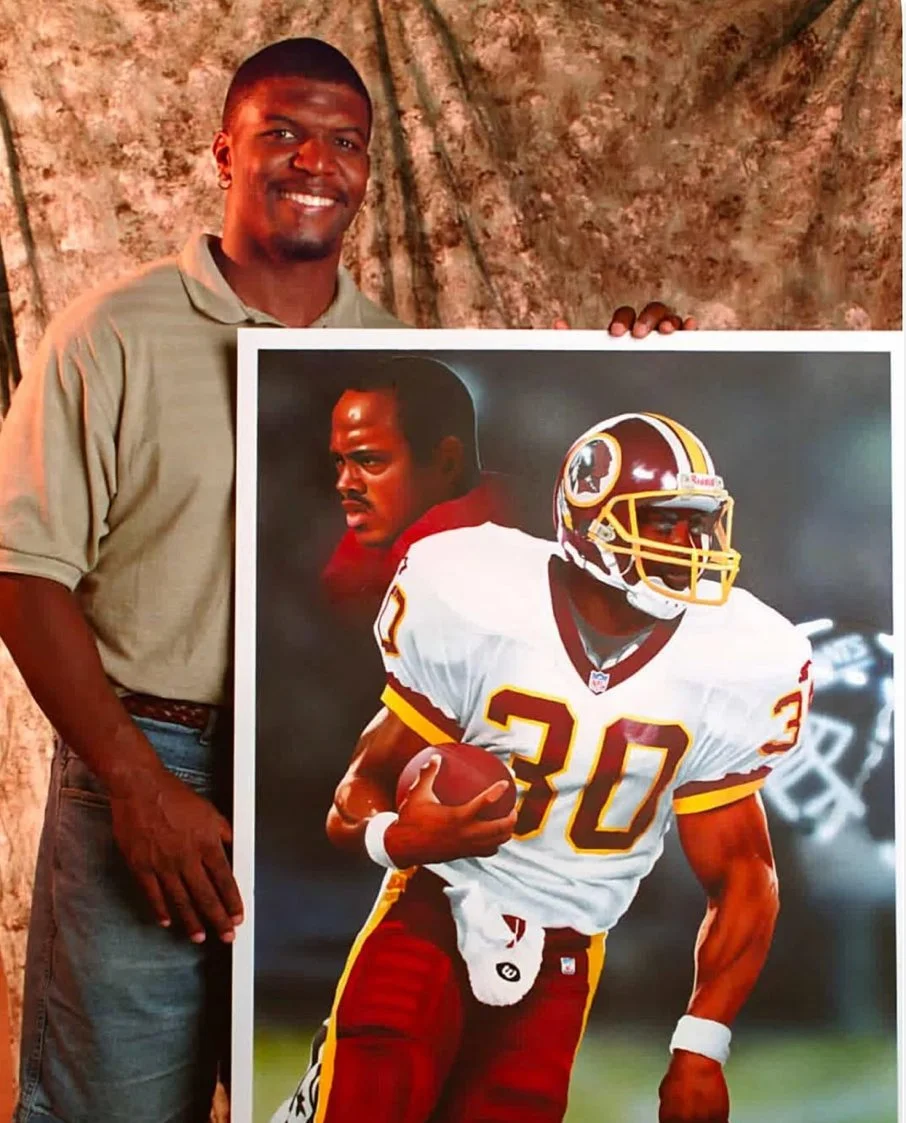
brushmaster terry
And before I jump off of the topic of “let people make art because the world is fucked up and everybody deserves a chance to figure out how to ignore it in a way that works for them,” I’ll circle back to another, more personal, example - a writing example. I journal a lot. It’s my way of thinking. Sometimes I even go back and look at those old journals, and one of those sometimes happened this morning, when I randomly flipped back and landed on an entry from this day, exactly six years ago. I guess back then I was occasionally writing haikus, and the one I found in the journal rang more true to me today than it probably did then.
Try to be prepared
For the newness of autumn
Like a leaf falling
-me, six years ago, not knowing that future Brian would read it and think “shit, there’s another whole season around the corner - things are still being made new!”
So I guess the point is - make what you’re gonna make, and even if it doesn’t make any sense right now, it might later. And if it doesn’t make sense, it might give you perspective. And if it does or doesn’t make sense or give you perspective, it’s still there, and it might move you to think about what it means now, whether it still holds up, whether that feeling or that image or that whatever still expresses a thing you would want to express today. In this case, for me, the answer is - mostly. But I’d change it a touch, if I were permitted to do so. Readers, am I permitted? To update my own journal entry from six years ago? Thanks. Good talk.
wakeup and await
the sharp newness of autumn
like a leaf falling
-me, this morning, getting weird in a newsletter
And that’s it. I don’t even know what just happened. Here we are, almost at the end, and– oops, I haven’t found a spot for this month’s playlist. So I’ll close out with a track list that has a little something for everybody.
Also, thanks again for reading. I hope this was entertaining or interesting and that you’ll write back and tell me about the time you saw a three-eyed fish in your local lake, or that time you ran into Brian Mitchell (ahem, NFL record holder for all-time kick return yards) at a sushi restaurant and he was very nice.
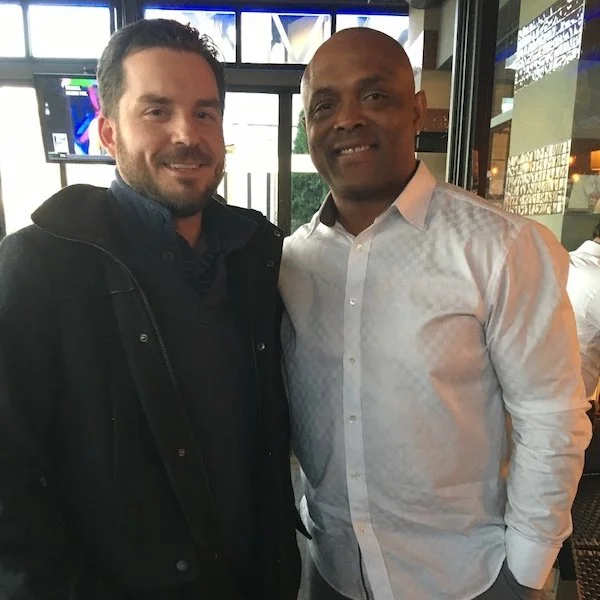
b-how and b-mitch
❤️✌️
Brian
This month’s moment of zen: the “LAST TIME” meditation.
The next time you’re dealing with some exhausting, tedious thing, probably being done in the service of some greater good but which in the moment is just the last fucking thing you feel like doing - pushing the kid on the swing for the 283rd time in an hour (or other equally deadening parenting activities); putting your pants back on at midnight to go pick up ginger ale for your very thirsty partner; pause for a moment and think to yourself - “It is objectively possible that this could be the last time I ever have to do this, and if it isn’t this time, it could be the next one, or the one after that…”
And then just sit with that for a moment. Because if it were the last time - if it were really the last time, and you knew it - you’d probably be feeling differently about having to do it, and maybe, just maybe, even thinking....
“aw, shucks, this isn’t so bad. I would even do it again one more time if I had the chance to.”